Category Archives: Downloads

Granular Sampler Download – Very Simple Grainer 02

Didn’t I say I’d have the next installment in this series ready “next week” a year ago? Dang.

Very Simple Grainer 02 from Peter Dines on Vimeo.

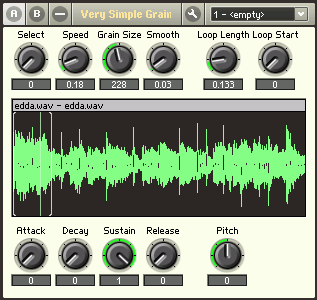
Here’s a new and improved version of the Very Simple Grainer, with some new features, fixes and a couple of new samples. I’ve moved controls around, added the very nice sounding Core saturator that comes with Reaktor 5, added LFOs to the grain size and speed parameters, and fine tuned a couple of other things. If you’ve been following the material I’ve posted here and at Noisepages, you should be able to puzzle it out. If you have questions or feature requests, post a comment.

Download Here

The first iteration, with instructional PDF, is here.

Update: you’ll want to add your own samples as I’ve only included two. Use this technique and set them all to a root key of zero.

Vintage Graphical Skinning Tutorial

The aptly named Jonathan Style creates some of the finest styles in Reaktor skins and GUI elements. In this post at his blog you’ll find a tutorial on creating your own graphics. He has a lot more material at his site so check it out – simply gorgeous graphics.

My own approach to Reaktor GUI design is minimal at best – I like to use the built in tools and maybe work with colors a bit, because my stuff is always in a state of rebuilding and flux. But if you have a finished work, laying a nice skin across it can really change the way you view it and work with it.

Frame 0.3 beta – download

I’m crossposting this from Lambent Studio because people are asking about it in the thread below, and Reaktor Tips gets more traffic; I guess I’ll post Reaktor related stuff here in the future, where people expect it to be. šŸ™‚

Here it is.

Tada! The initial release of the Frame looper, made to emulate the realtime-manipulable start and loop points of Ableton’s Simpler instrument. It’s a powerful and convenient way to play with samples, which makes the dearth of samplers that can do it so shocking.

Frame Beta 0.3 from Peter Dines on Vimeo.

In this clip I’m alternately adjusting start and loop points by clicking and dragging on the waveform, and using the knobs. The knobs can be mapped to MIDI controllers or (better) the high-res knobs on the Kore 2 controller. Initially I had tried to do this with the sample loop module, but that caused clicks because of the lack of crossfade / ramping. Eventually I hit on the idea of using a grain cloud module with grain overlap set to one – so the single grain, in effect, is acting as a loop. And the great thing about the grain cloud module, unlike the grain resynth, is that the grain can be arbitrarily long.

When I interviewed Phil Durrant, one of the things that came up was the lack of a split library in Reaktor 5 – there were only “premium” bells and whistles ensembles, and no simple, easy to modify examples. Frame is an instrument that tries to do just one thing, and do it well, with a clean easy to modify structure.

Read the notes in the instrument properties and tooltips. If you have suggestions for improvement, let me know, unless your suggestion involves sticking a reverb macro in it. šŸ˜‰

previously

Very Simple Grainer

All right, enough piddling about with theory and math and such. Let’s get down to making some noisemakers. I’m going to do things a little differently this time. I have constructed a dirt simple four voice granular synth – it is cut to the bone but still usable. Here it is.

When I was a Reaktor newbie I hated the complexity of granular instruments in the factory library and the user library. I had to cut through great tangled swaths of cruft to get down to the essence. So why not start with the essence?

Play with it, mess with it and figure out what the controls do. It should be perfectly self explanatory. Dig in and have a look at the structure. Add some of your own samples. Short 10 to 30 second snippets work well. The root note should be zero – see the last post on constructing sample maps for more information.

Ask questions. Let me know what you’re not sure about, and how you think it can be improved. I have some plans for this instrument and I’ll be posting about the changes as I make them.

Above all, play the instrument. I love the sound of a naked granular synth, with no extra reverb and chorus and filtering and other extraneous glop. Hold down a couple of notes and play with the speed and grain size controls. Pitch a harmonically complex sample down or just play it in a low register and hear the details that emerge. Not too shabby for a dirt simple instrument that barely even registers on the ol’ CPU meter.